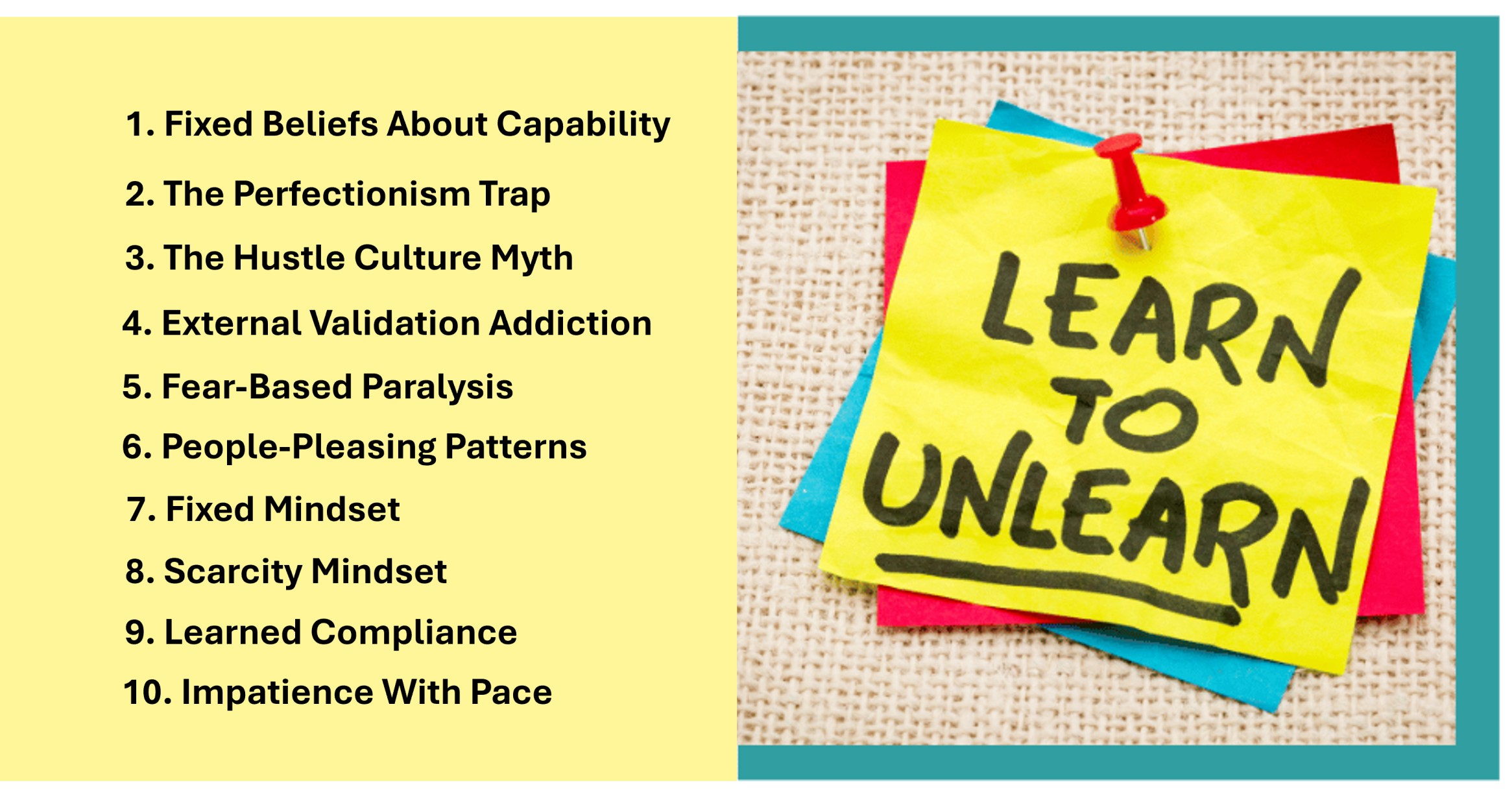
We've been conditioned since childhood, shaped by family expectations, cultural narratives, and societal rules that once served us but now hold us back. The path to real success isn't about learning more. It's about unlearning the beliefs that keep us small.
The 10 Invisible Chains
1. Fixed Beliefs About Capability: The lie that you're "just not good at this." The most fundamental limiting belief is the conviction that our capabilities are fixed and unchangeable. Neuroscience has definitively proven this wrong: -the brain remains plastic throughout adulthood, capable of forming new neural connections through effort and learning. Growth is always possible.
2. The Perfectionism Trap: Society celebrates perfectionism as virtue, but research reveals the truth: perfectionism triggers procrastination, slows decision-making, and creates a psychological prison where every mistake feels like a character flaw rather than normal learning.
3. The Hustle Culture Myth: The one that equates success with exhaustion. People measure worth by productivity, leading inevitably to burnout, damaged relationships, and deteriorating mental and physical health. The exhaustion equation is a lie. Rest isn't laziness, it's where creativity ignites.
4. External Validation Addiction: We learn early to seek external validation, stars, praise, approval. This pattern persists into adulthood, where we measure worth against others' achievements, job titles, and social media metrics. When self-worth depends on external validation, we become trapped in endless comparison, hesitant to take intelligent risks or claim credit for achievements and nothing ever we achieved feels like good enough.
5. Fear-Based Paralysis: The fear of failure can be paralyzing, preventing people from attempting new challenges, hesitating to ask for promotions, or staying in jobs that no longer fulfil them. The fear of being "not intelligent enough" or of being "too old/young" keeps talented professionals from pursuing career opportunities they could excel in. These beliefs create a barrier that makes it difficult to reach full potential. Action despite fear is what separates success from stagnation.
6. People-Pleasing Patterns: People-pleasing is a learned survival strategy where individuals prioritize others' needs above their own, rooted in childhood experiences where love was conditional on compliance. This pattern continued into adulthood leads to saying yes to everyone exhausting you, silencing your voice, and preventing authentic Leadership and creating shallow relationships where real connection is impossible because authenticity is sacrificed for harmony. You can't be truly known if you're constantly adjusting to what others want.
7. Fixed Mindset: The conditioning that limits growth, the belief that intelligence, talents, and abilities are essentially unchangeable, is often reinforced in educational systems that emphasize test scores and rankings, teaching students that they are either "smart" or "not smart," Neuroscience has now proven that this belief is fundamentally wrong: the brain remains plastic throughout adulthood, capable of forming and strengthening new connections through repetition and experience.
People with a fixed mindset see challenges as threats to their competence rather than opportunities to grow. When they encounter difficulty, they interpret it as evidence that they lack ability in that domain and stop trying. In contrast, those with a growth mindset believe that abilities and intelligence can be developed through effort and learning. They view challenges as opportunities, embrace learning, value feedback, and see others' success as inspiration rather than threat.
8. Scarcity Mindset: The scarcity mindset teaches that insufficient resources exist for success, creating fear about using our best ideas, investing in ourselves, or sharing knowledge. Yet the opposite is true: each executed idea creates compound interest for creativity. When we dare to use our ideas and invest in growth, we unlock even more capacity.
9. Learned Compliance: "Do what you're told. Don't question authority. Stay quiet." This conditioning to follow authority without questioning, silences the curious questioning mind, suppress our authentic voice, blocks creativity, prevents innovation, silences unique perspectives, and inhibit individuals from stepping into leadership, the very things organizations desperately need.
10. Impatience With Pace: Childhood conditioning that "slower = lesser" creates shame about needing time to think deeply. Over time, individuals internalize the message: "My pace is wrong. I have to be quicker to be acceptable." In adulthood, this manifests as impatience with themselves, rushed decision-making, difficulty with deep learning or reflection, and feeling anxious when not moving quickly, confusing stillness with laziness and productivity with worth. The fear that slower pace means less capability keeps them from exploring, learning deeply, or making thoughtful decisions.
Liboo (the Liberated Owl) recommends a 6 Step Unlearning Strategy:
1. Cultivate Self-Awareness: Through journaling and meditation, identify where your limiting beliefs originated. The space between stimulus and response is if your freedom to choose and from where change begins to happen.
2. Challenge With Evidence: Question each belief's validity. Find proof, check what wrong tracks are playing in your mind. Pause, Replace "I'm not good enough" with "I'm learning and growing." This isn't denial, it's truth-telling.
3. Embrace Growth Orientation: Surround yourself with people who challenge your thinking and inspire growth. A beginner's mindset opens doors that certainty closes. Be open to positive criticism from a well-wisher.
4. Practice Mindfulness: Watch your thoughts without judgment. When perfectionism whispers criticism or imposter syndrome suggests you don't belong, observe without identifying. You are not your conditioning.
5. Take Calculated Risks: Act despite fear. Start small. Keep records of successes and lessons. “if you lose – do not miss the Lesson” Gradually you will build evidence that you can handle uncertainty and recover from mistakes. Resilience is built through action.
6. Build Authentic Relationships: Find mentors, peers, and communities where psychological safety exists. Where people feel free to be themselves, innovation thrives. Sometimes it’s all right to ask for help and guidance – provided you have developed the wisdom of knowing whom to ask from.
The Truth You Need to Know
Unlearning is an ongoing practice requiring self-compassion and willingness to question what you've been taught. As you identify and release outdated beliefs, you make room for something more expansive and authentically aligned. You are no longer the child whose survival depended on compliance, perfectionism or people pleasing.
You are an adult with agency, wisdom, and the power to choose. The only limits that truly exist are the ones you continue to accept.
Unlearning is courage. Unlearning is freedom. Unlearning is the path to becoming authentically successful, not by exhaustion or external validation, but by alignment, fulfilment, and the freedom to be genuinely YOU.
Which of these 10 limiting beliefs has held you back the most? Share in the comments. Let's unlearn together.

Vineet Bhardwaj
Founder & Principal Coach - Liboo - Your Path to Growth & Wellness